
User and assistant text from the opted-in Pi JSONL artifact.
Signal 01 Insights Understand the work
Understand the work
behind the tokens.
Register independently deployed insight services, apply different policies globally or by tenant and project, and connect every result to the repository, session, source items, tags, and run that produced it—all from your own control plane.
PROJECT SIGNAL SAMPLE VIEW

github.com/earlgrey piproxy
repo linked Sessions 128 uploaded agent sessions
Requests 2.8k accepted model requests
Contributors 24 identified participants
Insights 37 durable entries
Distillation coverage86%
110 complete · 12 pending · 6 retrying 01 Pluggable processing
Multiple policies. Multiple services. One evidence boundary.
The gateway parses canonical Pi sessions, matches every active global, tenant, and project configuration, then calls the selected stateless gRPC processor. The gateway owns durable identity and provenance; the service owns the insight logic.
Bound input, remove thinking and tool records, resolve tags and configurations.
Return summaries, tagged results, source item IDs, usage, warnings, and proposed tags.
Store the run and provenance, then append accepted results to project knowledge.
Register the endpoint
Name, gRPC target, TLS or trusted-network plaintext, server name, timeout, active state, and a live health test.
Scope the policy
Attach a processor, instructions, tag behavior, summaries, input bounds, and a revision to global, tenant, or project scope.
Govern the vocabulary
Supply active tag names, descriptions, and usage counts to every service; choose whether a configuration may propose additions.
Audit the outcome
See configuration revision, project, input hash, status, session summary, insight count, usage, warnings, errors, and timing.
02 Repository identity
One project, however many checkout paths.
The plugin reports Git remotes, and the gateway normalizes SSH and HTTPS forms into a tenant-scoped project identity. That lets activity from different machines converge without merging unrelated repositories that merely share a folder name.
Observed as
git@github.com:earlgrey/piproxy.git https://github.com/earlgrey/piproxy /Users/team-a/code/piproxy Canonical project earlgrey / piproxy tenant scoped · stable id
earlgrey / piproxy tenant scoped · stable id 03 Knowledge surfaces
Four views of what the agent learned.
Raw session evidence, generated insight, prompt quality, and curated memory serve different jobs. The gateway keeps those layers distinct.
 Generated insights
 Keep the lesson, not the transcript
Agent observations and the distillation pass produce durable decisions, mistakes, lessons, and context that can be reviewed independently of a raw session.
 Prompt feedback
 See where the request caused rework
Project views separate prompt reflections from operational memory, making request quality visible without mixing it into the project runbook.
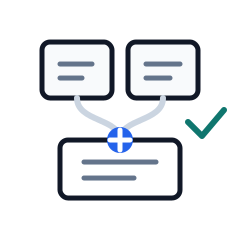 Curated memory
 Compact repeated knowledge
Repeated lessons can be compacted into a focused project brief. Retrieval and injection remain policy-controlled and can be disabled centrally.
Source attribution Know where an insight came from
Entries preserve their source type, conversation, and user attribution when available, so teams can validate the evidence before acting on it.
Generated insights source attributed
Decision
Use the stable repository remote as project identity; folder names are display hints only.
recorded by agent · conversation 7ba…Mistake
Do not treat an empty knowledge response as zero insights when the knowledge store is unavailable.
generated by distiller · user attributedContext
Usage attribution arrives from accepted proxy requests even when a canonical session upload is disabled.
recorded by agent · source linked 04 Evidence, not magic
Insight stays auditable.
The project view reports pending, skipped, failed, and complete distillation work. If the knowledge store is unavailable, the gateway says so instead of displaying a misleading zero.
- Distillation is opt-in and project allowlisted
- Raw session upload remains a separate client opt-in
- Knowledge entries preserve available attribution
- Curated memory can be inspected before it is reused
05 Runtime health
Know which client and processor are actually connected.
gRPC health tests, version headers, session metadata, run failures, and aggregated extension reports make both sides of the insight pipeline visible.
extension version on model usage processor health and transport check project and conversation correlation aggregated operation failures first seen / last seen / occurrence count